Showing posts with label hot tips. Show all posts

Wednesday, September 15, 2010

Appalling mobile phone plans

I thought Canadian telephone providers must be the world’s worst—but then I discovered Telstra, Australia’s major provider.

We’ve had mobile (cellular) service with them since April. We wanted a mobile each so we could connect with one another, and also to be able to make calls within Australia. As visitors, a two-year plan made no sense, so we opted for the prepaid mobiles.

The phones were inexpensive (~A$50) and the recharge amounts seemed reasonable at $30. The phones worked well in urban areas, and even when we were away from major centres, the reception was okay.

— I removed the several hundred word rant about the terrible Telstra service and complex plan details from here… Suffice to say I was frustrated! —

Telstra has a number of plans for prepaid mobiles, but use catchy terms like “150 free minutes” and “bonus time” to obscure the fact that they are all very expensive and restrictive. You can’t just buy time: you must choose one of the plans.

Telstra’s “Talk & Text” plan expires after 30 days, so if you haven’t used it, you lose it. The “Talk Time” plan runs for 60 days, but it costs A$0.40 to connect, then A$0.35 for every 30 seconds. The “Telstra Long Life” plan runs for six months, but calls cost A$0.75 for the first 30 seconds, then A$0.60 per minute…

“So just to be clear, if I go with the Talk Time plan you are recommending, a $40 charge will let me talk for 150 minutes?”

“Yes sir! 150 minutes to Telstra numbers.”

“Uh, okay, and how do I know if it is a Telstra number? And what is the charge if I dial a number that turns out to be with a Telstra competitor?”

“Sorry sir, there is no way to tell—but you could ask them when you make the connection. Or, you could call our service centre and ask them to check the number.”

Right. And that explains why the four supposedly free 1800 numbers we’d dialled to the car rental agency ended up costing nearly $30.

Calls to landline phones within Australia cost substantially less than calls to mobiles, and if the person you are calling is so inconsiderate to have chosen an alternate provider, you pay a premium.

Sounds like a good business model—if you can get away with it! For some reason, Telstra seems to be doing exactly that…

Coming to Australia and want to be able to use a phone? My advice would be to get a Skype phone for use in urban areas, and when you are not near a wireless Internet provider, be sure to have lots of coins for pay phones.

Thursday, May 13, 2010

The cost of “cheap flights”

IMG_6986Tiger Airways flight prices certainly support the “fly cheaper” tag on their promotional banner: we had paid just A$140 to get both of us from Melbourne to Brisbane—a two-hour flight.

How can they manage to provide such low-cost flights?

  • Online bookings. It may be possible to buy tickets at the counter, but we didn’t see anyone doing so—and there was no obvious counter.
  • An “extra” charge is levied for everything. Water in a 325ml bottle was S$6; weight surcharges for bags >15kg are steep; food is expensive (and pretty basic) on board—and they have signs imploring people not to bring food aboard (although there was no apparent reason other than people would then not buy food on board).
  • IMG_6987Use of minimalist airport services. The Singapore airport was not the new and fancy one; instead, it was a dingy hall with a McDonalds and minimal services. The Melbourne check in looked temporary, and the security check was about a slack as we’ve seen since the 1980s. Even the boarding was minimal: IMG_6990several passengers were very annoyed to have to walk down a long hall, and then out onto the tarmac to climb up stairs to board. (We rather appreciated the fresh air after the dingy terminal!) 
  • IMG_6991Crowd people into the plane. Just as well the seats didn’t recline on the Melbourne-Brisbane flight, because there was just barely enough room for my knees.
  • No on-board entertainment.
  • Weird flying hours. Our flight left at 6am, and the online ticket was pretty clear about being there at 4am to check in. We managed that, and were near the front of the line—but by 5am, the counters were closed so the staff could process passengers after security. If you arrived after 5am, too bad…

For a two-hour flight, none of the above were too onerous. The longer flights—like our Singapore-Perth flight—had seats that did recline, but none of the amenities common to more major carriers.

Are better amenities worth the extra cost? Fares for Melbourne-Brisbane flights later that same day were ~A$300 each, so for us, the A$460 saved meant quite a few nice meals…

Sunday, April 11, 2010

GPS evangelists?

One of our first purchases in Australia was a Garmin GPS.

We have one in Canada, and use it all the time—even for roads we know—so there was never any doubt that we would get one for Australia.

IMG_4937The wider screen on this newer model—a nuvi 265W—shows more of the map at once. Our old model—named “Penny” because of her very British voice—spoke the directions but not the names of streets. This model—not yet named, but currently set to the Australian voice “Serena”—manages to speak not just the street names, but even words we key in as destination names.

A new feature I really appreciate is the ability to save tracks. As we drive, the GPS records the time and location as a series of points, and I can upload these later to our computer. The track can then be viewed as an overlay in Google Earth, so we can see where we’ve been. As well, because both the GPS and our cameras record the time and date, I can use my RoboGeo software to add latitude and longitude to our digital pictures.

The biggest advantage of a GPS is that it takes the edge off of navigating. We always have a map with us, and usually plan our route to some extent, but having a GPS lets us enjoy the scenery rather than watching for our route. It reports the distance to the next turn, and a small icon gives a visual cue to prepare the driver for the type of turn.

We bought “Penny” in England and appreciated how it eased the adjustment to right-hand drive. The same is true here in Australia: a spoken instruction like “At the roundabout, take the third exit to Strickland Street” provides much more useful information than seeing on a map that we need to turn right.

When we return to Canada, I’ll acquire current mapping information for North America, so the same unit will continue to serve us. For me, a GPS has become an indispensible driving tool.

Monday, April 5, 2010

Double-check assumptions

IMG_4754We knew we would need to be efficient to see Singapore’s Jurong Bird Park and still make it to the airport for our 13:50 check-in. Despite the pouring rain, there was lots to see and we had to pull ourselves away by 11:45.

The MRT got us back to the hotel by ~12:45 time to shower, change, pack and get a taxi to the airport for our 13:50 check in. It all seemed very smooth, and we were congratulating ourselves at our efficiency as we presented our ticket confirmation numbers and passports.

But then… “And your Australian visas?”

What?? Canadians don’t need visas for Australia!

Unfortunately, we do. In fact, the little matter that we also hadn’t obtained visas for Singapore had apparently been overlooked as well…

“Not to worry”, the helpful check-in guy said. “It happens a lot. Go over to that counter and they'll give you an email address you can use to get one online from the free Internet at the McDonalds.”

Well, it wasn’t quite that simple. The info counter clerk made a quick call, and told us we’d have to catch a shuttle (with all our bags) for Terminal 2 to have things processed at the Singapore Airlines counter. We dashed out to catch the shuttle just in time to have to wait for his smoke break. Argh!

Anyway, with way more sweating than we’d expected—and an unexpected SGD$100 ATM withdrawal to pay for them—we did manage to get the visas. Another shuttle bus ride and were back to the same check-in guy just before he closed the flight. With great relief, we cleared through and got our flight.

Moral? Never assume anything when it comes to visas!

Read between the lines in hotel reviews

We had two nights in Singapore, and one was for an arrival after midnight. We’d checked online, and selected and booked a mid-range hotel. The reviews had noted that the “Fragrance Crystal” hotel was located in the red light Geylang district, but most had been fairly positive. Alternatives were either much more expensive or backpacker dorms. I booked and paid online, noting on the Agoda form that we would be arriving very late—possibly after 01:00.

Our plane was delayed so we didn’t arrive until nearly 02:30. The front desk had our reservation though, and gave us keys to a 3rd floor room.

The room was dismal. Not only was there noise from the street, but it smelled of smoke (despite being a non-smoking hotel), and there was just a sheet over a rubber mattress with a rather dirty blanket. When Katharine called the desk, she was told that “no sheets are available” and “we cannot control if someone smokes in a room.”

We thought we might just cope, but even the pillows smelled of smoke. I called back to insist they find a sheet, new pillows and a clean blanket. At nearly 04:00, the items arrived, and we soon fell asleep—only to be jarred awake by an unrequested wake-up call at 06:00!

Apparently they had neglected to cancel it from the previous guest.

I spoke to the manager when we did get up some time later. He listened, apologized, and said he would upgrade us to a proper room. No excuses or waffling—and he was true to his word. The 7th floor back room was quite acceptable, and we had a good sleep the next night.

Our reservation clearly let them know the room would be empty until late, so we suspect that the 3rd floor room had been “rented out” without management knowing.

Lessons?

  • Plan to pay a bit more to avoid a red light district. The hotel location was reasonably convenient to the excellent Singapore MRT system, but the walk to the station had garbage in the street and some disreputable characters along the way—certainly not typical of the rest of Singapore.
  • Check the room before moving in, even if it is very late and they claim it is the last room. If we’d done that, they would have at least had to find bedding sooner—or found a different room.
  • When there is a problem, speak to management. Shouting would not have helped—and may well have worked against us. By just stating the facts, the manager was able to rectify the situation without losing face.
  • Online sites like Agoda.com take full payment at time of booking. Both of our nights were fully paid, so changing after the first night would be complicated (at least). If there is an option, just pay a deposit.
  • Use online sites like TripAdvisor or Agoda’s own feedback to rate hotels. in our case, the bad experience was certainly part of our stay, but the manager’s actions at least helped raise our rating to some extent.

Saturday, April 3, 2010

Watch those exchange rates!

We thought we’d planned things pretty well for leaving Thailand. After buying some food for the plane, and donating the remaining loose change, we had four 1,000 Thai bhat (BHT) notes in hand to exchange to Singapore dollars (SGD).

The posted rate at the airport was 22.66, so our 4,000 BHT would be 176.52 SGD. The exchange booth wasn’t near our gate, so we decided to wait until we arrived in Singapore to exchange our notes. First mistake…

Everything on Tiger Airline flights is “extra” but we had expected that no-charge water would be available. Unfortunately not—so when we asked for some water, the smiling hostess unscrewed the caps and passed them to us. “That will be $6.40 sir.”

For two small bottles of water? Yikes! I found my wallet and pulled out one of the notes. “Uh, sorry… all we have are 1,000 bhat notes.”

“No problem sir. At our onboard exchange rate of 27.14, that will be $30.40 less the water, so here is your change in Singapore currency…” Mistake number 2: carry smaller notes!

IMG_4833We arrived very late into Singapore—and learned that Tiger Airlines flies into the “Budget Terminal” instead of the modern Changi terminal. The currency exchange booth was still open, but the rate was 23.53—much better than the rate on the plane, but still more than at Bangkok.

Withdrawing cash from an ATM incurs additional bank charge fees, but having to exchange currency adds even more to the effective exchange rates.

Tuesday, March 23, 2010

Returning is so much easier

As we left our plane from Saigon, the signage and halls of Bangkok’s Suvarnabhumi airport had a welcome familiarity. Immigration was quick and hassle-free; our bag arrived shortly after the carousel started, and the customs clearance was a mere wave.

As we turned out of the arrival hall, a sign with our names on it greeted us: we’d arranged online for a car to bring us to Pattaya, and she was there waiting for us. A few minutes later, we were ensconced in the air-conditioned comfort of a new car, and our 21-year old woman driver was whisking us along the highway.

We’d booked a room at the Orchid Guesthouse—again online with only email confirmations—and were greeted at the gate by Brian, the new manager. We paid the driver, checked in with Brian—and were settled into our room less than 2 hours after landing.

Online bookings help make travel so much easier—but returning to a familiar place certainly helps take the edge off of arriving!

Monday, March 22, 2010

Saigon solution: Medical tourism 101

Imagine being gripped with a major pain in the jaw, which intermittently throbbed and threatened to take your head off… and then just as suddenly disappeared.
Ow.
That’s what I’d been feeling for months. Over-the-counter pain relief drugs were no longer stopping the sometimes stabbing feeling… What was it?
No sooner had we settled into Saigon’s quiet Hoang Phong Hotel than I said to Eric: “Let’s find a dentist.” In moments, he’d fired up the Internet and found West Coast International Dental Clinic -- a ten minute walk from the hotel. It was 19:00 on Thursday, March 18.
Katharine at the West Coast Clinic.
Once inside the immaculate clinic, I felt reassured that here in Saigon, I could find excellent care. Fluent (in English) receptionists asked how they could help. Immediately I was whisked into an examining room – where Eric was also made comfortable.
Dr. Andrew Tsang, originally based in Vancouver, entered. After after enquiring about my symptoms, he took x-rays and examined my tooth with a focussed blue LED light, which revealed a bad fracture in the second-last molar on my right, lower jaw. Would the tooth need to be extracted? Or, could an attempt be made to save it, if the fracture proved not too deep? He was unsure and booked a second appointment with a colleague.
X-ray after cleaning out two of the four root
canals in Katharine’s tooth.
To make a longish story short, the procedure which followed took three more visits. Dr. Diem welcomed me into her office the next morning at 10:00 at which time she agreed with Dr. Tsang’s diagnosis. She recommended an operation that afternoon at 13:30. Everyone hoped she could save my tooth.
 She did. On Friday afternoon, Dr. Diem discovered my tooth had four roots, two of which were so badly infected she couldn’t complete a root canal… even after two injections. So she packed my tooth and we booked a next day appointment, this time with an anaesthetist.
How many dentists do you know who would relinquish their Saturday day-off to complete an emergency operation for a traveller? Now wonder the same for anaesthetists!
On Saturday morning, an anaesthetist joined Dr. Diem and the two women set to work. After my anaesthetic injection, I awoke with the job completed – and mumbling something about giraffes and zebras jumping about inside my mouth…

Dr Diem completing the root canal procedure.
One more visit allowed Dr. Diem to ensure the temporary crown she’d inserted was okay. It was, and she fully expects it will last until I can either return to her Saigon clinic in November, or to my own Canadian dentist after my return to Canada.
No wonder Dr. Diem told us Saigon aims to surpass Bangkok and Hong Kong as SE Asian medical tourism destinations. While I was there, Eric and I met many international patients – from Canada, Australia and New Zealand.
With superb care, top-of-the-line technology, fluent English, and a hospitable, clean environment, West Coast International Dental Clinic has my vote of confidence. And the price? A third of what the procedure would have cost in Canada, not even counting the anaesthetic.
Medical tourism? Why not? With prices at home rising and queues lengthening, it makes sense to consider going to a country where professional assistance can be obtained quickly, relatively inexpensively – in a destination worthy of exploration, to boot!

Wednesday, March 17, 2010

Calling home v2

We’ve had Skype installed on our computer for several years, but hadn’t used it more than a few times. Our dial-up connection was practically useless, and the satellite connection had too many annoying gaps.

By the time our connection speed improved dramatically last year, Skype had fallen off our radar. However, we were eager to see how VOIP (voice over Internet protocol) tools worked while travelling with our netbook.

Now we’re converted.

With decent Internet connections almost everywhere we’ve been in SE Asia, we’ve been able to call wherever we want. It sometimes seems a bit odd to be talking at a screen, but the connections have been excellent—better than most speakerphones in fact.

Calls to another Skype user are free, but they need to be online with Skype running for that to work. I bought some Skype credit online so I can make a call to any telephone. The credit gets used as you talk, and the rates vary. For example, calling anywhere in Canada costs 2.4c per minute, but calling a friend’s mobile in Thailand costs 13c per minute. The rates are listed within the Skype window, and the amount of credit you have is shown in real time. Making a call is intuitive: choose the country and dial. No need to remember arcane country codes.

After chatting with friends back home from the privacy and comfort of our hotel room the other day, we marvelled at how different telephoning has become since we were last in this part of the world.

Then—in 1983 in Bangkok—a call home to Canada involved going to a special building and being assigned a booth where an operator dialled the number. Calls needed to be prepaid, and were very expensive.

With mobile phones and tools like Skype, staying connected with people at home is a very different experience today.

Saturday, March 13, 2010

Silk shirt extravaganza

I like silk shirts. Silk feels good against my skin, and can be warm in the cold or cool in the heat.

P3090144Hoi An is renowned for its tailors—and especially for silk garments—so I decided to have a couple of shirts made.

“Long sleeved, very nice colour… for you twenty-five dollar!” The seamstress at Kimmy Tailor measured me in lots of different places. “Come back tomorrow for fitting!”

IMG_3846I loved the rich colours we’d chosen, but both Katharine and I were not so impressed with the tailoring. The seams were not straight, and the pocket was a bit crooked. “No problem! We fix it… come back tomorrow!”

Friends we’d met had raved about a different tailor, so instead of ordering blouses for Katharine from Kimmy, we went to Yaly Couture. The selection of cloth was better, it was busier, we liked “Lydia” who did the measurements—and the price was the same. We ordered two blouses for Katharine, with fittings the next day.

Meanwhile, my shirts were ready at Kimmy’s and the problems had indeed been fixed. A custom fitted shirt feels fantastic, and I liked them so much I decided to order two more of the same style in different colours. “Ready tomorrow mister!”

IMG_3932The next day at Yaly’s, it was clear that they were the more professional outfit: Katharine’s blouses were loosely tacked in several areas to allow for adjustment, and the buttons and holes had not been cut. Lydia fitted each one expertly, and told us to come back later the same day for the final fitting.

We picked up my shirts from Kimmy’s and then Katharine’s from Yaly’s. No comparison: although the Kimmy ones were well made and fit properly, the Yaly blouses were much better made.

Katharine looked at me and shrugged. “Well Eric, if you want more, now is the time to do it…”

And that is how I ended up with eight custom-tailored silk shirts from Vietnam! Guess I’ll be okay for shirts for a few years…

Tip: If you have an item of clothing you really like, bring it. The tailors excel at copying, and can make any adjustments you may need. Allow 2–3 days to have items made—but additional items with the same pattern can be made in most places in a day. The biggest cost variable is in the quality of the cloth: labour is cheap, so spend a bit more for top quality cloth.

Friday, March 12, 2010

Postal service, Vietnamese style

We just sent off a big box of stuff we’d been collecting since Laos.

P3120009When we asked about getting a taxi to get our collection of bags to the post office, Anh at the front desk laughed. “Oh no, they will come here!” Sure enough, within half an hour, a woman from the post office arrived at our hotel with scales, tape, and a large cardboard box.

What we had wouldn’t fully fit in the box, but that didn’t deter her. She packed what she could into it, taking care to keep fragile items inside and well protected. Then she taped the remaining items—a bunch of silk lanterns—to the top so she could finish the job at the post office later.

The overflowing box weighed 17kg, and she estimated that it would need another kilo for packing material and an extension for the box. Forms were filled in and an amount for the postage, packaging and insurance calculated. We paid her, then offered to help her bring the box to her car.

P3120014“No car, just motorbike!” She laughed as we brought everything to her little motorbike outside. I’d have at least tied it on with bungee straps, but she just giggled as she put on her mouth mask and helmet.

With her box of equipment jammed in front of her, and our precious 17kg box balanced on the back, she drove away, holding the box with one hand behind her!

Can you imagine service like that from Canada Post?

P3120016

Saturday, February 20, 2010

Money matters

Getting a wad of bills adding up to 700,000 is a bit unnerving—even if it is really only about C$90.

In Laos, the currency is “Kip” (LAK) and the few ATMs in Luang Prabang will only dispense a maximum of 700,000 at one time. For most Laotians, this would provide food for a family for quite a while, but it can disappear quickly when a typical tourist meal for two costs 110,000 Kip.

The US dollar is still the preferred standard here, and many costs are quoted in USD. If you have them, dollars are happily accepted; if not, an exchange rate converts the price to Kip. The rate varies but is generally (in February 2010) around 8,400 Kip to USD$1.

But how much is that in Canadian dollars? Checking for a rate online can give a ballpark figure, but ATM and bank fees can change the effective rate dramatically. Our Canadian bank charges C$5 for an international ATM transaction, and the Laotian bank charges an additional fee in Kip. For relatively small withdrawals, these charges will end up boosting the real exchange rate.

We check our bank statement online to see the actual amount debited to calculate a real rate, and it demonstrates why larger withdrawals make more sense. For example, the 500,000 Kip withdrawal on February 18 ended up being a debit of C$65.73 with a C$5 fee, so the effective rate was 7,069 Kip to C$1 (500,000/70.73). A withdrawal of 700,000 the next day was C$91.16 with the same C$5 fee, so the effective rate for those Kip was 7,279 to C$1.

A 10,000 Kip beer paid from the first withdrawal will be C$1.41, but C$1.37 from the second. This isn’t a big difference for a single beer, but the 3% on a guesthouse bill of 1,045,000 would be 31,350 Kip — enough to enjoy 3 beers.

A small inexpensive calculator helps us develop a sense of costs in Canadian dollars. I put the real rate into the calculator memory so I can use it to divide common prices in Kip. Renting two bikes for 35,000 Kip each is C$4.80; an 80,000 Kip massage for two is C$10.99; and an hour of Internet access for 6,000 Kip works out to C$0.82…

After a day or two, we seldom need the calculator. Mind you, it still feels strange to think nothing of spending 120,000 on a nice meal!

Thursday, February 18, 2010

Slow boat down the Mekong: pay a bit more

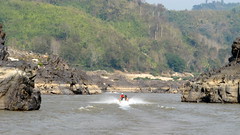
The towns of Chiang Khong in northern Thailand and Huay Xai in Laos straddle the Mekong River that defines their common border. Both are heavily reliant on the steady flow of tourists beginning the “classic” boat trip down the Mekong to Luang Prabang.

A burst of activity every morning brings ferry loads of people from the Thai side to wait in immigration lines on the Laotian side before boarding various classes of boat for the downstream journey.

The “fast boats” can make it in seven hours, but the 5–6 people on board have a bumpy, noisy ride, and the helmets they need to wear makes picture-taking impractical.

The “slow boats” take two days, with an overnight stop in Pak Beng. The public versions have wooden benches, and pack in as many people as possible. These are commercial river boats, so can stop for passengers along the way. Many such boats take turns operating as luxury boats, wherein the wooden benches are replaced by comfortable upholstered seats, and carry a limited number of people.

We had been planning to take a slow boat, but were becoming apprehensive after reading forums where people described sore bottoms from hard seats, being stuck in direct sun, excessive drinking and cigarette smoke — as well as a general melee for getting seats and then finding accommodation in Pak Beng. It was beginning to sound like a hassle instead of a highlight.

Amongst the horror stories in a forum thread about the slow boats, one comment about a positive experience prompted me to email Adisak at Nagi of Mekong — despite some followup responses that made him sound unreliable. I got a response immediately. Not only was he prompt, but provided details for days and costs. We had no specific dates at that time, but kept in touch, and by the time we were ready, we let him know. He booked our selected hotel in Chiang Khong (their web site was broken), and picked us up the morning of the cruise. We fully expected to be part of a larger group, but learned that we were alone with one other couple: the entire boat and an English-speaking Lao guide for two days!

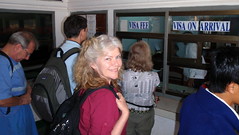
Adisak crossed with us and helped by explaining the crazy immigration process: everyone pushes and congregates at three mall windows as the very methodical Laotian officials process the passports and take cash for the visas as if there was no crowd at all. Knowing that there is a process — however bizarre it may seem — made it a lot easier to cope with!

Passports with new visas in hand, we were whisked off to the boat, where our bags and the other couple were waiting. We thanked Adisak for his help and he waved as we pushed off. We only then realized he hadn’t asked for payment. When I asked Pet, our Lao guide, he nodded and smiled. “It’s okay, pay later.” (We did!)

As we passed the first of the public boats loading up, we were glad to have paid the premium as people with big bags scrambled up to claim the good seats. Slower people, or those less fortunate in the immigration process, would have noisier seats near the back or be stuck on middle of a bench.

The public boat ticket prices are much lower, but an accurate comparison is hard to make. Different sellers charge different rates, and the boats rotate in service, so quality can vary. I spoke to one couple who had paid 1,200 THB each (~C$38) — but then had to pay for the ferry across the river, plus a tuk tuk to take them and their bags to the dock, plus food on board, plus a dismal room in Pak Beng…

For 4,600 THB (~C$144), we had comfortable seats, excellent food on board, a well-informed English-speaking guide, several interesting stops, and a comfortable room with breakfast in Pak Beng.

All of the logistics were looked after for us, so there was almost no stress. We arrived in Luang Prabang feeling relaxed and stimulated.

The extra cost was a very small price to pay for an unforgettable, once-in-a-lifetime trip.

Sunday, January 31, 2010

Getting around in Thailand

Getting to places can appear overwhelmingly complicated when the language is different—and even more so when its written script is not even remotely familiar. But visitors do get around, so it is simply a matter of figuring out how everything works.

IMG_0891In Thailand it seems totally chaotic at first. Small pickup trucks with welded tubular frames and sideways seating toot as they approach to indicate that they have room for you. In Pattaya, there was usually no indication of where these “bhat buses” were going, but we found that they made loops along popular routes: if we found ourselves turning away from our destination, we could push a buzzer button and hop off—paying the driver 10 bhat each (~30 cents).

P1260067The bhat buses fill up as they make their way, and if you are brave, you can hang on to the looped tubing at the back and actually see things a lot better. The view from inside is limited—but while the outside view is great, the prospect of potential bodily harm if the driver has to make a sudden stop is rather daunting!

A map is a good thing to have, although most drivers have no idea how to read it even if it is bilingual, showing the Thai. We found that landmarks are best: with the name of a hotel or a shopping area, bhat bus drivers were good at getting us there (or at least close).

The “tuk tuks” we’ve been using in Chiang Mai are small motorized tricycles with fairly comfortable seats and a canopy top offering similarly limited views. They weave in and out of traffic with just finger-breadths to spare and seem only marginally safer than the ubiquitous motorbikes.

IMG_1528On Saturday we needed to buy intercity bus tickets by going to the Arcade bus stop in Chiang Mai. Our destination would be Chiang Rai, and we’d been advised to book at minimum two days in advance to procure tickets because there are only 16 or so seats available on any day… We hired a tuk tuk to get us there: 140 baht. We liked our capable, fun driver whose name was Mr. Horse, so hired him for the rest of the day: the total for 5 hours was just 400 bhat (~$12)! Moreover, we hired Mr. Horse for the next two days: he safely transported us to Baan Tong Luang tribal village and to the Wat overlooking Chiang Mai.

It just goes to show that the real costs here are not labour, but fuel and capital.

The long-haul buses are a very reasonable way to get around too. We reserved two seats on an overnight bus from Pattaya to Chiang Mai for 725 bhat (~$22). It took 11 hours, was air conditioned (to the point we were glad to have the provided blankets!), and they served water, juice, and more snacks than we could eat. What was particularly interesting was that the driver and full-time assistant were in the front, completely closed off from the passengers. The immaculate attendant also put on the video for everyone to watch. Incidentally, this bus arrived in Chiang Mai 45 minutes ahead of schedule.

Getting around is much easier than it looks—and inexpensive methods are quite comfortable. Looking online first helps; as does having a decent map. Fortunately, the language issues are seldom a problem: just smile and ask and just like us, you’ll discover someone will always be there to help.

Tuesday, January 26, 2010

Food markets: Everything that moves is edible

IMG_1152Exploring Pattaya’s food markets is enlightening. As anyone who has travelled in Asia/India and such spots knows, “everything that moves” is fair game and can end up in your rice bowl.

IMG_1155Knowing this, I’m unsurprised to see cockroaches, giant water beetles, ant larvae and other insects I cannot identify for sale in the food market. Not only that: insects represent such tasty and readily available protein sources that street vendors will cook up a stir fry combo of bugs and veggies to eager customers who queue for a tasty snack.

IMG_1153Further down the narrow, congested aisle in the shaded food-and-everything-else market, I heard desperate cheeping. Yes: my personal nightmare was the sight of perhaps two dozen little songbirds resembling sparrows, peeping in fear and scrambling in a knot, trying to stay as far away from the cage door as possible.

Poor things.

IMG_1154The next stall sold tiny tortoises and turtles roughly the size of a Canadian loonie coin, through to ones which were the size of dinner plates. Another cage contained toads.

It’s easy to fall into the trap of being judgemental. It’s prudent to fight such thoughts, but also to be firmly aware of what you are supporting when you order a meal. We’ve not (yet) been offered bush meat for example, but know that this may be available at some destinations.

Just as in Canada when ordering fish and other meals, it is up to us as consumers to be as aware as possible, so we can support agri-food operations which we would wish to condone.

Saturday, January 16, 2010

Arranging trips in Thailand

Activities for tourists are everywhere, and it seems like every street and hotel has an agent to sell tickets. Presumably they all get a commission, and it is hard not to assume that a price is higher than it should be. When we booked transportation from Pattaya to Koh Chang, the hotel owner’s web site said a taxi would be ~140 bhat from the ferry, so we were tempted to just pay for the minibus to the ferry—instead of paying the extra 300 bhat to go all the way.

Good thing we let ourselves be persuaded by the travel agent: as we left the ferry in our reasonably comfortable minibus we saw dozens of bhat trucks (taxis) waiting for fares. And by the time we’d arrived at the far end of the island—and past the many resorts and up and down precipitous switchback roads—we were very happy to have paid the extra 160 bhat each!

We’d used the travel agent our friends use, and she had been delighted to know they’d recommended her. Of course, if she’d ripped us off, our friends would know and she would lose their business…

Bottom line: agents can make things a lot easier. But of course, do some research; ask questions; use connections—and don’t assume that everyone is trying to rip you off.

Jomtien Beach’s fabulous restaurants

Pattaya’s Jomtien beach area boasts fantastic restaurants and food is beautifully prepared, fresh and served by helpful staff. Faves so far:

Pong Kitchen Restaurant: Eric chose Tom-Kha ( Coconut milk soup with shrimp) for 80 baht; I selected Guay-Tew-Nam (Lettuce broad-noodle soup with chicken). I didn’t order French fries but learned their Thai name is Mum Farang (foreigner) Toad.

Continental: Great for breakfasts with real brewed coffee rather than the Thai staple of Nestle or other brand’s instant. Muesli with fruit (fresh pineapple, strawberries and bananas) delicious.

Lan Bao: Thai food excellent but we had to sit in overflow seating on the actual street (which is under dusty construction) with the dogs. Food great; ambiance a let-down. Note to self: get their early so as to sit inside else walk kitty-corner across street to Pong Kitchen.

Motorbikes and bhat bus accidents

Motorbikes and bhat-bus taxis (glorified pickup trucks fitted with two sideways seats taking 10 passengers) are notorious here in The Land of Smiles. And now we know why. En route from Pattaya’s Jomtien Beach to Koh Chang we observed two nasty accidents with EMS personnel administering first aid prior to hospitalizing the victims. And we just missed seeing a bhat bus collide with a hydro pole – victims boarded the ferry. Ouch.

Problem is that although there are driving rules & regs, “anything goes” and who knows whether farangs (foreigners) who drive have ever driven a motorcycle previously? No helmets, either.

As for the bhatmobiles as I call them, they’re better from the point of view that Thai drive them and know the road “rules” and traffic flow/unpredictable predictability. This is truly a driver/passenger and, perhaps most importantly, pedestrian-be-aware culture.

We’ve seen this previously, of course, in all our travels – from Cairo to Hyderabad. However, I personally have never before seen three accidents and their victims. Sobering and instructional, that’s for sure.

Friday, January 15, 2010

Thai Visa run

Visa runs are where tourists like us or farangs (foreigners) who are property owners must exit the country for anywhere from 3/4 to an hour or so, to renew their Thai visa. It’s all legal; but that doesn’t mean it’s not a nuisance to folks like our friends who have purchased a condo here. To keep them company we joined them in their air-conditioned hired minivan, driving the 250 or so kilometres from Pattaya to Pong Nam Ron, the border town.

The drive took us past expected sights such as pineapple, banana, and rubber plantations – along with unexpected ones such as a large vineyard. Yes, Thailand is becoming known for its wines – apparently.

Our visa for this trip allows us two entries into Thailand. We procured this in Ottawa prior to our departure. However, we understand that it’s very, very easy to have one’s visa renewed and extended, for a price of course. No need for visa runs such as this, pending what one’s doing/where one is: When we arrived at Bangkok’s airport there was a visa area where people without their necessary papers could get one.

It was odd indeed to arrive at Pong Nam Rong – a dusty/desolate border crossing with Cambodia – and watch as our friends paid and had to physically walk out of Thailand, be processed and walk back into the country. Then off we drove, back to Pattaya.

And so it is in the Land of Smiles: our only question is, if it’s so easy to extend visas, why have them or at least, why have such restricted times, particularly for property owners?

Monday, January 11, 2010

Hot tips for BKK

1. The taxi touts were not as bad as we’d expected. It was easy to ignore them as we made our way to level 1 where we joined four quick queues to get an “official” taxi. The attendant prepares a chit with the destination and calls the next available driver. The charge is whatever is on the meter plus a 50THB surcharge—well worth it for the ease and confidence it assures!

2. Getting away from the airport. We wanted to get to Pattaya, and learned it would be about 1100THB by taxi. One of the many free shuttles at the Arrivals exit whisked to the its last stop, the public transport center. The airy clean station has public transit buses into Bangkok and longer haul buses to outlying destinations. First class A/C bus with reserved seating to Pattaya was 124BHT each. But we learned another tip: the bus looped back to the airport to pick people up directly at the airport!