Showing posts with label Katharine. Show all posts

Thursday, April 1, 2010

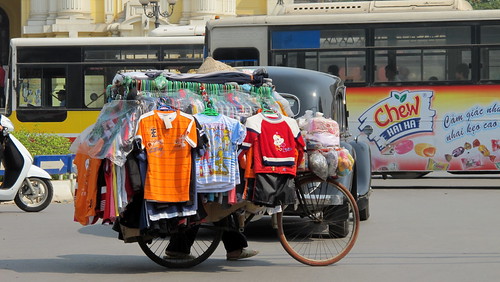
Asian traffic: Everything goes

What do Bangkok and Pattaya (Thailand), Hanoi and Saigon (Vietnam) share? Crazy traffic.

IMG_3421My intro to the wild world of “everything goes” when driving was while entering Bangkok by taxi from the airport. There we were in our hot pink cab, cruising along the highway peacefully, when all of a sudden I spied an unforgettable sight.

A phalanx of three motorcyles full of families… all driving the wrong way up an exit ramp. Speechless, I watched as one driver turned her motorcycle into the highway traffic, while the other two fellows wove through oncoming vehicles to turn onto the opposite lane.

That’s traffic, Asian style. Anything goes but drivers actually watch the vehicle(s) ahead of them. This way, everyone keeps moving, slowly (usually) but with purpose.

Actually it appears to work… fairly well. After all, we did see several nasty motorcycle accidents, with injuries, but that’s another story.

Monday, March 22, 2010

Saigon solution: Medical tourism 101

Imagine being gripped with a major pain in the jaw, which intermittently throbbed and threatened to take your head off… and then just as suddenly disappeared.
Ow.
That’s what I’d been feeling for months. Over-the-counter pain relief drugs were no longer stopping the sometimes stabbing feeling… What was it?
No sooner had we settled into Saigon’s quiet Hoang Phong Hotel than I said to Eric: “Let’s find a dentist.” In moments, he’d fired up the Internet and found West Coast International Dental Clinic -- a ten minute walk from the hotel. It was 19:00 on Thursday, March 18.
Katharine at the West Coast Clinic.
Once inside the immaculate clinic, I felt reassured that here in Saigon, I could find excellent care. Fluent (in English) receptionists asked how they could help. Immediately I was whisked into an examining room – where Eric was also made comfortable.
Dr. Andrew Tsang, originally based in Vancouver, entered. After after enquiring about my symptoms, he took x-rays and examined my tooth with a focussed blue LED light, which revealed a bad fracture in the second-last molar on my right, lower jaw. Would the tooth need to be extracted? Or, could an attempt be made to save it, if the fracture proved not too deep? He was unsure and booked a second appointment with a colleague.
X-ray after cleaning out two of the four root
canals in Katharine’s tooth.
To make a longish story short, the procedure which followed took three more visits. Dr. Diem welcomed me into her office the next morning at 10:00 at which time she agreed with Dr. Tsang’s diagnosis. She recommended an operation that afternoon at 13:30. Everyone hoped she could save my tooth.
 She did. On Friday afternoon, Dr. Diem discovered my tooth had four roots, two of which were so badly infected she couldn’t complete a root canal… even after two injections. So she packed my tooth and we booked a next day appointment, this time with an anaesthetist.
How many dentists do you know who would relinquish their Saturday day-off to complete an emergency operation for a traveller? Now wonder the same for anaesthetists!
On Saturday morning, an anaesthetist joined Dr. Diem and the two women set to work. After my anaesthetic injection, I awoke with the job completed – and mumbling something about giraffes and zebras jumping about inside my mouth…

Dr Diem completing the root canal procedure.
One more visit allowed Dr. Diem to ensure the temporary crown she’d inserted was okay. It was, and she fully expects it will last until I can either return to her Saigon clinic in November, or to my own Canadian dentist after my return to Canada.
No wonder Dr. Diem told us Saigon aims to surpass Bangkok and Hong Kong as SE Asian medical tourism destinations. While I was there, Eric and I met many international patients – from Canada, Australia and New Zealand.
With superb care, top-of-the-line technology, fluent English, and a hospitable, clean environment, West Coast International Dental Clinic has my vote of confidence. And the price? A third of what the procedure would have cost in Canada, not even counting the anaesthetic.
Medical tourism? Why not? With prices at home rising and queues lengthening, it makes sense to consider going to a country where professional assistance can be obtained quickly, relatively inexpensively – in a destination worthy of exploration, to boot!

Monday, February 22, 2010

Luang Prabang’s laid-back beauty

The Spend Another Day in Laos booklet we discovered in our Chiang Mai guest hotel gave us the impression we would thoroughly enjoy this UNESCO World Heritage Site.

IMG_3355We did. First, its architecture is lovely: traditional heritage wooden homes (many set in oases of vegetation) contrast with ornate often yellow and white French Colonial public buildings. Throw in the 30+ usually spectacular Buddhist Wats – especially if the monks are chanting – and you have beautiful “bones” for a city.

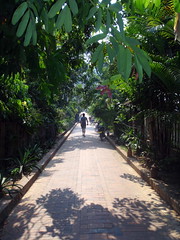
P2260083Secondly, dappled sunlight in back lanes and alleys conspire to make Luang Prabang a walker’s paradise. We were well shaded and our senses delighted by draping bougainvillea, fragrant frangipani, and stiffly rustling banana trees while exploring these narrow thoroughfares.

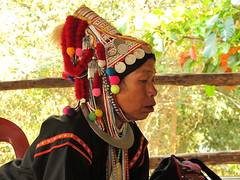
Thirdly, there are many museums to explore. We were fascinated with the Traditional Arts and Ethnology Centre which explains Laos’ many tribal peoples. After watching videos of sacred Taoist initiation ceremonies and learning about the different typical clothes the Hill Tribe Peoples make, we purchased textiles and crafts at the museum’s shop. Knowledgeable staff informed us about the tribes, use of materials as well as how items had been hand dyed, woven, and embroidered. However, the pièce de résistance of the centre was the free library at its on-site cafe. We spent perhaps 1 1/2 hours reading: I enjoyed Grant Evan’s book, The Last Century of Lao Royalty (ISBN 978-994-9511-66-4).

IMG_3096The National Museum (formerly the Royal Palace) was equally fascinating, where we toured the Royal’s private home and living space, Buddhist temple, as well as gardens, complete with circular fish pond. (In Evan’s book, he quotes one of the princesses saying how she loved playing beside the pond – and how her mother cautioned her and her siblings not to get too close, lest they fall in.)

Laos’ last King and Queen’s disappearance is never explained here at the palace, other than by relating it directly to a Buddhist legend where the king supposedly left his people to follow the ascetic life of a monk. So it was fascinating to read in Evan’s book that King Savang Vatthana’s death occurred in the communist “re-education camp”, Sop Hao, in northern Laos. He, the Queen and one prince perished after being rounded up by the communists in 1977. Apparently the first admission of the Royals’ death was published in Bangkok World, January 1981.

IMG_3122Such is life here in Laos and Luang Prabang, where Buddhism, communism, and people’s daily lives weave a complex, textured pattern.

Sunday, February 14, 2010

Akha Hill Tribe home stay

How do travellers locate an authentic, old-style Akha village in which to enjoy a home stay?

IMG_2234Enter an NGO called AFECT Asia, which kept on surfacing as a highly recommended outfit after we started our research on the Internet. Founded by the late Dutch anthropologist Dr. Leo von Gesaw, this organization is dedicated to helping the Akha maintain their traditional way of life, culture, language, and animist religion.

After browsing AFECT’s website, we booked a 7-day trip with them, which would involve a 4-day/3-night stay at Sai Jai Pattana village followed by a four-night stay at their Chiang Rai dorm, where we would travel with AFECT staff and visit other villages.

Our guide, interpreter and host for most of our stay was Athu Pochear, director of AFECT’s many Akha projects. After spending a week together, he would become a friend with whom we’ll stay in touch. He’ll help match our skills to volunteer projects when we return.

After booking our seven-day stay on the Internet, the stage was set: What would our home stay actually be like?

Our four days with Apae and Megah Pochear at Sae Jai Pattana village proved to be a moving, special opportunity to participate in and learn about the Akha hill tribe’s way of life prior to volunteering. We were warmly welcomed by our hosts who shyly stated they thought we may not be comfortable at their home. Surprised, we asked why.

After an exchange in Akha, Athu explained Apae and Megah’s concerns: “It’s the roosters. They’re so noisy! They crow at 1:00, 3:00, and 5:00. And then there are the dogs.” Gazing at the roosters, hens, chicks, and dogs in the yard, we thought to ourselves that yes, it would be noisy.

“Please, don’t worry,” I said. “We are here in your home and village, eager to stay and experience your ways. If it’s still okay, may we stay?”

Megah beamed; Apae nodded. Megah showed us our room: a king-size cot with typical hard Thai mattress. The toilet was a shared squat affair, outside in a corrugated iron hut with a cold water faucet serving as shower.

Perfect: with basic needs met and gracious hosts, we’d be a-okay.
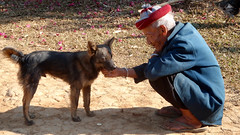
P2100016And so our first evening began. Beckoned upstairs onto the shaded, breezy verandah of their bamboo home, we shared a whiskey with Apae and Athu’s 87-year-old father, Aq Bawl – “grandfather.” Megah placed steaming bowls of delicious, carefully spiced foods onto a low, circular bamboo table. She and Apae had prepared dinner over the two open hearths in their dirt-floored kitchen. Akha men usually cook the meat, and certainly cooking dinner together seemed a pleasure for this obviously loving husband and wife.

Accompanying us for the four days were Leeja and Edd, young Akha men who would be our guides, translators and companions. Between mouthfuls of rice, green beans, buffalo meat, and other unidentifiable but delicious foods, they explained the morning drill. After breakfast at some undetermined time we would head on a jungle trek, which sounded both interesting and exciting. “The boys” were eager to show off their AFECT projects, their village, and their capabilities.

Immediately after dinner, at 8:30 p.m., everyone went to bed: this would be the pattern of our stay: early to bed and early to rise .
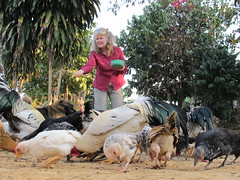
IMG_1989The roosters crowed boisterously right on schedule. Dogs joined in, greeting the dawn. Repeatedly. Sleep was banished. After feeding the chickens (a chore I eagerly adopted) Megah served breakfast and I helped with dishes. Then it was time to herd the cows (well, more accurately, follow their lead) down the village lane to their pasture: this became our morning rhythm.
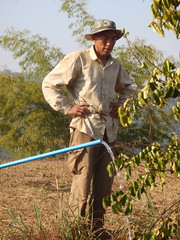
P2090118The four days sped past: the jungle trek revealed AFECT’s water irrigation project whose source was a spring bubbling out of the forested hills. A two-kilometre pipeline led to a hillside demonstration garden and that afternoon we would witness Apae joining the last segment of pipe and seeing water spout forth to irrigate the test garden.

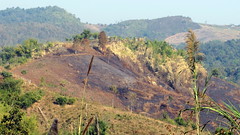
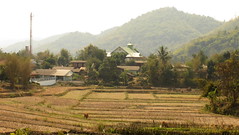
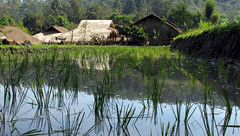
Leeja proudly showed off his personal project: building a set of 15 rice pounders on the banks of a reservoir, where water would be power the mechanisms. Considering that women traditionally laboriously pound rice by primitive foot-powered technology, Leeja was rightly proud of his efforts. Another day’s hill walk revealed the swidden agriculture whereby field crops are rotated, allowed to go fallow sometimes for several years, and regularly burned. Other explorations took us through emerald-green rice paddies where women and men were doing the backbreaking work of planting rice.
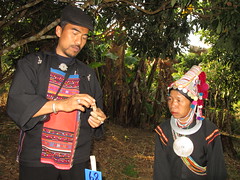
IMG_2303On our last day we met a shaman, Akaw Ayi, who spoke to us (via Athu’s interpretation) of how she helps the sick and troubled by being a direct link to the spirit world.

Would we recommend an Akha home stay with AFECT at Sae Jai Pattana village? Definitely… with a couple of cautions: accommodations are rustic – and some Akha foods may prove challenging if you’re squeamish or a strict vegetarian.

Is it worth expanding your comfort zone? Absolutely. After all, Akha and other people who adapt to our world are equally challenged by our customs.

We both would like to return to volunteer in an AFECT project.
Saturday, February 13, 2010

The Akha: Thai hill tribe politics

The Akhas are one of ten or so hill tribe peoples living in northern Thailand. Their ancestral homelands included Tibet and China’s Yunnan province, but due to territorial conflicts the Akha are among many of the world’s displaced peoples who have migrated to other lands. For approximately the past 200 years, Akha have lived in Burma, Laos, and Thailand.

Their history, in other words, is a journey – and it’s far from being over.

IMG_2275While travelling in the Land of Smiles, we hoped to stay at and experience a traditional and hence “authentic” Akha village. It proved more challenging than we’d anticipated. That’s because although Thai tourism promotes tribal peoples’ colourful costumes and quaint lifestyle, hill tribes are a largely disenfranchised people in crisis. This is true not only for the Akha, but also for other hill tribes such as the Long-necked and White Karen, LaHu, Yao, and Lisu.

What crisis? It appears that the majority of hill tribe people do not qualify for Thai id cards, neither can many own land or possess passports. Therefore, movement within Thailand let alone legally to Burma or other countries is impossible.

IMG_2132Moreover, the Akha traditionally live in the mountainous regions, preferring to establish villages on the saddle of a ridge. They have an agrarian (swidden) lifestyle and are superb hunters in the jungle-forest habitats.

Such traditions immediately create conflict with the Thai government. One reason is because of the forestry industry: the government’s attempts to control it, create plantations of non-fast-growing pine, and establish some forest preserves mean the Akha (and others who live further down the mountain slopes) have been compelled, quite literally, to move their villages out of newly designated forestry preserves – sometimes at a moment’s notice. Some claim they’ve woken up to find saplings planted in their rice fields in an obvious move to hasten their departure and emphasize their disenfranchised status.

Repeated, forced evictions translate into loss of hope and culture. It produces poverty because as the Akha and others like them are relocated further and further down the mountainside, their traditions and agrarian livelihood directly compete with not only other tribes but also, the lowland Thai people. Due to population pressures, these fully recognized Thai citizens are encroaching further and further up the hillsides. Not only are relocated hill tribes being forced to share their villages with one another (causing increased inter-tribal competition and necessary compromises to further dilute their unique cultures), they must also mix with the Thai.

In one sense, we could nod and say “it’s the way of the world.” But this sort of comment is easily thought and spoken if one is respected, employed, and secure. However, if you are a hill tribe person or community witnessing the unravelling of your culture, loss of identity is bitter and depressing. At best.

Another problem for the hill tribe peoples is degradation and loss of their traditional beliefs and culture due to possibly well-intentioned missionaries. Many Akha speak with sadness if not barely concealed outrage over “the Christians” who build missions (including not only churches but residential or non-residential schools). Just as we have experienced in Canada with our all-too-recent troubled history of enforced residential schools for our First Nations peoples, the Akha and other hill tribes are losing their identity thanks to planned, organized erosion of their culture.

The Akha are animists who have a firm belief in the spirit world. They build and tend spirit houses, spirit gates, and perform many sacred ceremonies wherein the spirit world is woven into their daily lives. In Chiang Rai I saw many beautiful animist spirit houses pushed over and broken. Desecrated. When I asked my Akha guide what had happened, he replied, “It’s the Christians; they do this to us to discourage our belief and try to convert us to their varied faiths. I’ve never understood why there are so many types of Christians: can’t they even get along with one another?”

Good point and the answer is… No.

IMG_2481As merely one example of obvious inequality, it was discouraging to see a Christian mission being erected on the dominant hill of a Karen village outside Chiang Rai. The immense, obviously expensive church was under construction; however, the missionary’s home was complete and stood behind an imposing iron gate.

It is better to give than receive, Christ taught. But when animist hill tribe villagers live in seemingly eternal poverty and the missionaries place a donation box outside their grand edifice, who is eternally giving, and who is receiving more than their due?

With residential schools and missions being built, continual challenges to procuring Thai identity cards, and all the other challenges to Hill Tribe traditions, it seems as though these diverse cultures may be doomed.

But then again, their lives are a journey and so far, they’ve survived myriad setbacks. I hope they continue not only to survive, but to prosper, also.

Thursday, February 4, 2010

Chilling in Chiang Rai

There we were, enjoying views of the countryside from the front seat of our Chiang Mai to Chiang Rai bus when Eric gasped, “Move over, man!” nanoseconds before the sickening crunch.

IMG_1677Our driver had slammed into a truck parked on the shoulder of the highway. It was a clear, sunny day with no traffic. Intriguingly (to us) the two saffron-clad monks who’d been chatting with the truck driver high-tailed it down the highway. Inauspicious to be at the scene of an accident? Who knows?

And, who knows what would happen to our driver, who was emotional about the accident.

Within an hour, another Green Bus had collected us all, and we arrived in Chiang Rai only 50 minutes late. Athu, from Afect Asia, a Dutch NGO with which we’ll be travelling and doing some volunteer work, met us as arranged and whisked us to Afect’s headquarters. Due to my chest and throat cold, we requested altering our trek start from February 4 to Feb 8. Fortunately, they could accommodate this request and, after a welcome cup of herbal tea and a chat with a Spanish volunteer worker, Athu brought us to our guest house.

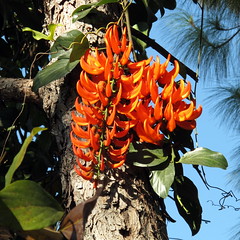
IMG_1733Baan Bua Guest House is an oasis in downtown Chiang Rai. Resembling a small motel, its emerald green and ochre facade overlooks a tidy garden where tables and chairs allow us to have meals, a Chang (Elephant brand) beer, or simply chill and read. Vivid clusters of orange blossoms on immense vines and the chatter of red-cheeked bulbuls emphasize the oasis ambiance: after seeing some of the other guest houses, we’re glad to be here. Co-owner Tim, with her husband Brian, is absolutely fluent in English, having studied in Texas for two years. Delightful, attentive, informed: it’s wonderful to really be able to chat with a Thai beyond the basics!

Monday, February 1, 2010

Exploring in Suthep-Pui National Park

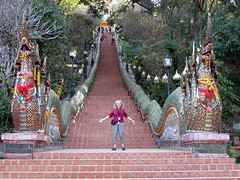
IMG_1531On Monday Mr. Horse swapped his tuk-tuk for an air conditioned truck. Picking us up at 8:00, we left Chiang Mai behind, ascending the nearby forested mountain which is known as Suthep Pui National Park. Our destination? Wat Phrathat Doi Suthep, the symbol of Chiang Mai. Here we climbed the 306 stairs to enter the Buddhist temple, wandering about and appreciating how tourist observers such as ourselves easily mix and mingle with the devout. We always marvel at the Buddhists who accept being the focus of attention. We know that back home, worshippers in most organized faiths would not be as welcoming of tour groups and photographers in their midst while they pray.

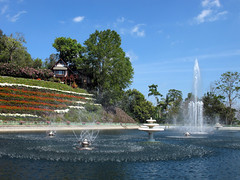
IMG_1607Leaving the Wat we continued our ascent, visiting the Royal gardens at Phuping Palace. Although beautiful, we felt it unnecessary for the Royals to insist on charging an entry fee: why couldn’t people be allowed to appreciate the gardens in the same way we Canadians can freely explore and enjoy Rideau Hall?

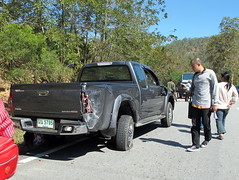
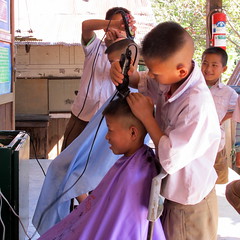
IMG_1626After visiting Baan Tong Luang the day before, you can bet we were eager to visit “real” villages so on Mr. Horse drove, climbing still further up the narrow hairpin road which suddenly became single-lane. The road ended at Khun Chang Kiang village where Eric and I strolled its dusty red-earth lanes and wooden homes. Shouts of laughter beckoned us: we discovered a group of schoolboys getting their heads shaved at Srinehru School. A gay banner welcomed visitors, and the boys smiled at the camera, continuing to shave one another’s heads with what appeared to be very dull shears. Eric declined getting a cut…

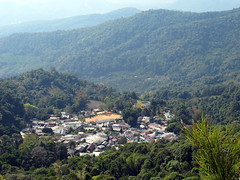
IMG_1638We retraced the narrow road and stopped at a lookout to see a tidy village in a valley below. Seeing our interest, Mr. Horse turned off the main road to take us to Doi Pui, another Hmong tribal village. Narrow, wending streets led us to the village heritage museum. Entry was 10 bhat apiece. Although exhibits were dust-covered and sparse, they were nonetheless interesting—but the piece de resistance was the “sample house.” Sample indeed: it was being lived in and was full of refuse, plastic bags and detritus. No windows and we thought it was emphysema-inducing just to step inside.

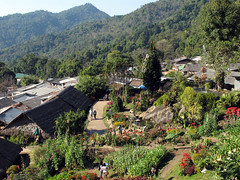
IMG_1652Beyond it, however, was the real highlight: a terraced garden extending up the mountainside where cascading water made its cooling sounds. Amaryllis were in full blossom as were opium poppies – part of the museum display apparently – and many other blossoming plants. Three pavilions beckoned us onward and after the ascent to them on narrow Nepalese-like stone steps, we appreciated the astonishing cool breezes which rewarded our efforts.

Time. It does have a way of passing. We descended to greet Mr. Horse who returned us to Lai Thai… And none too soon: it was a long but fun 9-hour day.

Sunday, January 31, 2010

Chiang Mai: Nearby Baan Tong Luang Village

Mr. Horse the tuk-tuk driver proved indispensible to us: for a great price he transported us about Chiang Mai to a variety of handicraft outlets and galleries. With the breeze keeping midday heat at bay, he safely negotiated the sea of motorcycles, cars, other tuk-tuks, bhat buses – and pedestrians leaving us time to look about and appreciate the heartbeat of the city.

He soon understood what we were interested in: culture, nature and handicrafts. Soon he was making recommendations and, after a nanosecond of deliberation, we placed ourselves in Mr. Horse’s capable hands.

IMG_1409Off we scooted to Baan Tong Luang village. Think of Upper Canada Village – but where the traditionally costumed “animators” are authentic hill tribe peoples who live and work on the farm. This put what at first appeared to be a disappointingly over-the-top tourist venue into perspective. Politically, the hill tribe peoples have suffered from the hands of various oppressive regimes. In fact, they still do. Members of four tribes: Karen, Lahu Shi Bala, Palong and Hmong live here, marry, have children, work the fields, look after and work with their elephants, and make and sell traditional clothing and crafts.

IMG_1391Touristy? We spent 2 1/2 hours here photographing the tribal people, watching the women weave, playing with the children – and learning how to shoot coconuts with a traditional bow and arrow. (I thoroughly impressed the old gentleman who asked me to try to hit a small green coconut on a stump: I got two direct hits and got very close to it three times. Neither he nor Eric knew my parents used to call me “Annie Oakley” when I was young…)

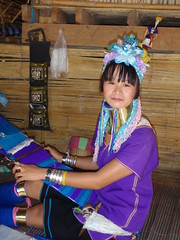
P1310052I ended up purchasing several scarves from the Lanna long-necked (aka “giraffe”) women. In fact, it was a thrill to buy a brightly coloured one which was being woven before our eyes!

We later learned that had we taken a bus tour, we would only have had 45 minutes to experience this worthwhile village project.

Friday, January 29, 2010

Chiang Mai Delight

Where to start? We arrived in this former capital city of the Kingdom of Lanna by overnight bus from Pattaya.

During our first afternoon we wandered the streets of the old city whose foundations and brick fortifications date back to the 13th Century. Our destination was Chiang Mai City Arts and Cultural Centre. Here we learned the Thai traditionally believe cities are living entities with a body and soul, whose prosperity depends upon its birth chart. Auspicious times have ebbed and flowed for this great city, once the capital of the Kingdom of Lanna. Today, it is part of the Kingdom of Thailand of course, but it’s still the centre of Northern Thailand.

Typical for the two of us, we jumped into action and booked ourselves into a Thai cooking course for the next day. Choosing a school is challenging due to the fact there is so much choice. However, as soon as we saw classes offered at the Thai Organic Farm, we knew we wanted to support this endeavour for sustainability and food security reasons.

IMG_1222For 900 bhat apiece we were picked up in a bhat truck, taken to a local market where ingredients we would be using were explained, then driven for 20 minutes or so through the countryside to the farm. En route we spied water buffalo grazing as well as plantations of bananas interspersed with papaya and many vegetables. City noises and pollution gave way to calm views: this confirmed we’d selected the right school for us.

IMG_1242Once at the farm, our teacher “Tommy” toured our group of 12 about, showing us vegetables, fruits and herbs such as Thai eggplant, lemon grass, and limes which we would be using in just a few moments. Then it was time to cook! Tommy stepped us through the menu of items we’d all chosen to make.

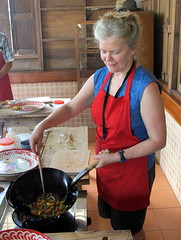
IMG_1335Both Eric and I were able to select 6 different types of food each, as did all the other couples. After watching Tommy’s demonstrations, it was easy to prepare such foods as green and red curries. All of us delighted in tasting and sharing our dishes after Tommy taught us how to eat sticky rice (by rolling it into a ball and dipping it into the curry). After lunch we cooked two more dishes, and then Eric and I were dropped off at Lai Thai Guest House. A fabulous day well spent!

Our clean room (690 bhat) at Lai Thai was comfortable but a bit dingy. Designed in a Northern Thai style, walls were honey coloured, made from woven, split bamboo while the floor was chocolate-coloured teak. After two nights we switched to room 219 overlooking the (cold) but nonetheless inviting swimming pool. After a few attempts, we decided not to dine here: service proved a bit iffy and the food? We cooked better Thai ourselves! Nonetheless, Lai Thai’s central location made it perfect for us and at roughly C$21/night, it was a good price.

Chiang Mai is full of museums. However, more unusual are the government-sponsored stores which showcase goods made by northern Thai hill tribes. We visited the “Thai Hill Tribe Products Promotion Foundation Under Royal Support” – quite the mouthful of a name. And if you think that’s odd, check out the label on the clothes: “BPP Hill Tribe” refers to Border Patrol Police. A brochure explains, “In buying these handicraft products, you help the hill tribe artisans to earn an alternative income [as well as] the border patrol police school students and their families.”

Browsing enabled us to research prices for traditional clothing, quilted fabrics, silver and other items we might purchase later from tribal peoples themselves.

We would soon discover many opportunities to barter…

Tuesday, January 26, 2010

Food markets: Everything that moves is edible

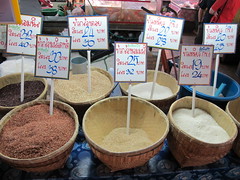
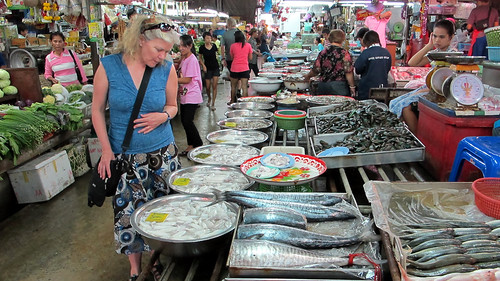
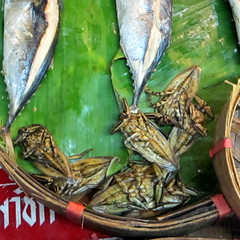
IMG_1152Exploring Pattaya’s food markets is enlightening. As anyone who has travelled in Asia/India and such spots knows, “everything that moves” is fair game and can end up in your rice bowl.

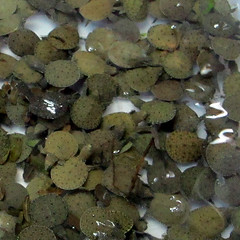
IMG_1155Knowing this, I’m unsurprised to see cockroaches, giant water beetles, ant larvae and other insects I cannot identify for sale in the food market. Not only that: insects represent such tasty and readily available protein sources that street vendors will cook up a stir fry combo of bugs and veggies to eager customers who queue for a tasty snack.

IMG_1153Further down the narrow, congested aisle in the shaded food-and-everything-else market, I heard desperate cheeping. Yes: my personal nightmare was the sight of perhaps two dozen little songbirds resembling sparrows, peeping in fear and scrambling in a knot, trying to stay as far away from the cage door as possible.

Poor things.

IMG_1154The next stall sold tiny tortoises and turtles roughly the size of a Canadian loonie coin, through to ones which were the size of dinner plates. Another cage contained toads.

It’s easy to fall into the trap of being judgemental. It’s prudent to fight such thoughts, but also to be firmly aware of what you are supporting when you order a meal. We’ve not (yet) been offered bush meat for example, but know that this may be available at some destinations.

Just as in Canada when ordering fish and other meals, it is up to us as consumers to be as aware as possible, so we can support agri-food operations which we would wish to condone.

Thursday, January 21, 2010

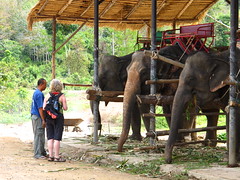
Bonding with Pang the elephant

Who knew elephants can be as mischievous and fun-loving as your pet dog or horse?

Seventeen-year-old Pang (pronounced “Bang”) taught us just that as we experienced a jungle trek followed by a swim with him in a river’s deep pool.

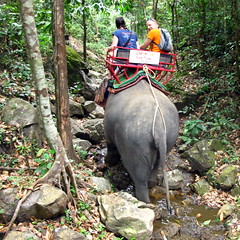
IMG_1001Just getting on Bang was an adventure: the howdah (elephant seat) is secure on their broad back, but what was comical was ascending a set of stairs to a platform 3 metres high, then scrambling onto the howdah, with the mahout’s (the elephant’s driver and companion) help. And then we were off!

Now, Bang didn’t lope about. Instead, we went on a fairly sedate walk. As he strolled, his great feet fell gently on the narrow pathway lined with rubber trees (yes, we walked through a plantation where rubber was being collected in sap buckets slightly reminiscent of our maple sap gathering).

Using his sensitive trunk he grabbed at delectable leaves and vines, stuffing them into his mouth. From time to time he delighted us  by trumpeting: amazing noise emanating from his tubular trunk.

IMG_0987Only one other elephant was on our trek, and Bang ensured Nam Taan didn’t get too far ahead. From time to time he stopped snacking, hit second gear and “sped” past his pal. Hilarious!

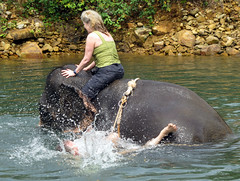
But the best part was the swimming with the elephants. We strolled to a river where a platform awaited for us. The howdah was removed, then we clambered onto Bang’s bare back. I was the lucky one, seated right behind his head on his (relatively) slim neck, just behind his ears. Eric had no grip: his fate was to do the splits on Bang’s back. Suddenly, the mahout was off and instructing his charge to dive into the water, twist and turn to try to unseat us. Talk about laughing!

IMG_1036Eric had no hope and was off in an instant. I, however, stayed on – and on, to Bang’s astonishment as well as his mahout’s. Bang surfaced several times, twisting his great head to look at me in what seemed to be surprised amusement—I know… I’m hopelessly anthropomorphic! Finally, however, he succeeded and after a deep twisting dive I was unseated.

And then we tried to clamber back on. Bang was so cooperative. There’d have been little hope but for the fact he extended his back leg, creating a most helpful step so we could climb “up his broad butt”—which he never did manage to submerge.

IMG_1083After our trek I met the owner of this elephant trekking outfit. Preecha told me he’s from a tribe who, for 200 years had been hunting wild elephants in Cambodia, bringing them back to Thailand, and training them in forestry work. Now that the forestry industry is in serious decline, these great beasts and their mahouts are unemployed. Hence the proliferation of elephant trekking outfits.

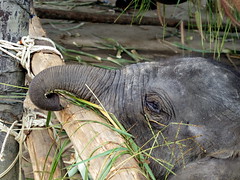
IMG_1067I hope Bang has a good life. At his “stable” we met an 18-day-old baby who we were able to pat. Ever so cute, it was “gumming” its bamboo fence enclosure, for all the world it looked as if it was teething, while proud Mama looked over its wee form, ensuring all was well. Odd: we noticed the teat of the mother is located behind her front armpits. You’d think they’d get in her way – but I’m sure evolutionary design has figured all that out better than me.

Monday, January 18, 2010

Koh Chang snorkelling

Surprise! We’re picked up by the outfitters not by boat as anticipated but by 2 young Thai on… the dreaded motorbikes. Off I go, doing what I swore I’d never do: riding pillion unprotected, hugging the driver. Eric’s following and yes, we slowly negotiate the rock-strewn road leading from Bang Bao’s Hillside Cottages to the pier where we weave through pedestrians, all of whom are strolling to meet their snorkel or other boat tours. We are safely deposited in front of our spectacular turquoise-and-scarlet painted boat and, in 20 mins we’re off on our four-island snorkelling tour. As promised, only approx 30 people on board: some divers, snorkellers, a “nursery” of tots (cute!), one baby, and some sightseers.

We had purchased our own snorkels & masks at Jomtien Beach but Eric rented flippers for 100 bhat ($3Cdn) for the day. The snorkelling was good but due to last night’s whopping windstorm (according to our host this is not ordinary – he did not sleep a wink all night he said), the visibility was quite poor.

Nonetheless, we had a blast.

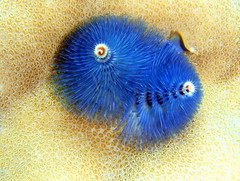
Favourites included coral reef invertebrates known as Christmas Tree worms which came in unbelievable neon blue, gold and scarlet – all had sparkles, too, and were approx 3 cm tall. And definitely, although they damage the reef and an indicator of an unhealthy reef, the big black sea urchins were spectacular. Diving down to look at these spiny critters reveals five bright, silver-white sparkling “eyes” and a tangerine orange and neon purple “mouth.” Stunning colours against the jet black bodies. You don’t want to step on one of these as the spines are apparently very painful. However, they’re easy to avoid while being beautiful to behold.
A surf parrot fish tried to touch us: evidently it was attracted to us for some reason so we had fun observing it for a several minutes worth of interaction. Its fins resemble hummingbirds’ wings with their constant motion, while its body of emerald green with yellow, blue and red highlights was utterly beautiful.

The many corals as well as the giant clams with their amazing coloured “big lips” of purple and other hues, and iridescent fish were all fun to experience. More than anything, the turquoise water was beautifully warm. A languid day of wonderful exercise, where our Thai hosts were friendly and fed us well.

Thumbs up for a great deal.

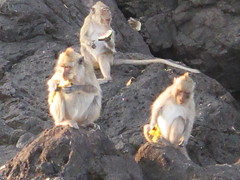
Thumbs down for any ecotourism perspective: there was no discussion whatsoever of the Mu Kho Chang National Marine Park, nor did staff adhere to the park principles of not feeding the fish or the monkeys which we saw on the rocks en route back to Bang Bao. I was disappointed not to receive any educational component, and not to have others (especially the children) get this much-needed, caring perspective.
Sunday, January 17, 2010

Koh Chang: Elephant Island

Boarded the minivan we hired to take us from our Pacific Jomtien hotel to Bang Bao fishing village on Koh Chang, which takes its name (Chang is elephant in Thai) due to the island being the shape of an elephant’s head. Supposedly. We’re picked up promptly at 7:30, thankfully being the first to board, as the van fills up with 10 passengers total. Driver gets lost twice…

Then we’re off and after 4 hours we arrive at the ferry docks where we drive on a waiting vessel. The crossing takes about 40 minutes and en route we purchase a coconut and a lemon “milkshake” for 40 bhat each. Deliciously refreshing – but no dairy involved, solely the fresh fruit/nut and ice along, of course, with sugar syrup. In other words, so far the Thai milkshakes have no milk: another mystery…

Koh Chang is surprisingly mountainous with hairpin roads leading to a western coast lined with resorts, ATMs, diving/snorkel outfitters – and the inevitable sarong & souvenir shops. Everyone is let off and we’re alone heading to the southernmost village, Bang Bao. Here’s where Eric discovered Cliff Cottages for $10/night. Remote, rustic, no partying, the sound of the surf: this is what the website promises. We’re warned on the website to bring a padlock to secure our cabin.

Our first cabin, #20, is lop-sided, threatening to capsize down the cliff & has a glimpsing view of the ocean if you stand just so. We ask to change, selecting #10, a tad more robust and closer to the clean but shared showers/toilets. No view. The pink mosquito nets look great but I am concerned about cockroaches & other creepy crawlies. I have to curb this concern… I know I’ll find them on this trip or, more likely, they will find moi!

We eat here, on-site, choosing two curries, a green and Panang curry, which turns out to be a red curry. Delicious.

We stroll to the pier, amused if not startled by the ubiquitous motorbikes which toot then push past strolling tourists, shopkeepers and snoozing dogs on the 2-metre wide pier! We book a snorkelling trip for tomorrow (why not jump in & have some exercise & fun?!). For 500 bhat apiece (about $13 Cdn) we’ll be fed and tour 4 islands in Mu Koh Chang National Marine Park.

Then to bed amid a whopping, lovely wind storm. We appreciate its cool as we lie in bed with the pink netting billowing about. Lovely.

Saturday, January 16, 2010

Jomtien Beach’s fabulous restaurants

Pattaya’s Jomtien beach area boasts fantastic restaurants and food is beautifully prepared, fresh and served by helpful staff. Faves so far:

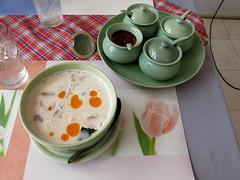
Pong Kitchen Restaurant: Eric chose Tom-Kha ( Coconut milk soup with shrimp) for 80 baht; I selected Guay-Tew-Nam (Lettuce broad-noodle soup with chicken). I didn’t order French fries but learned their Thai name is Mum Farang (foreigner) Toad.

Continental: Great for breakfasts with real brewed coffee rather than the Thai staple of Nestle or other brand’s instant. Muesli with fruit (fresh pineapple, strawberries and bananas) delicious.

Lan Bao: Thai food excellent but we had to sit in overflow seating on the actual street (which is under dusty construction) with the dogs. Food great; ambiance a let-down. Note to self: get their early so as to sit inside else walk kitty-corner across street to Pong Kitchen.

Motorbikes and bhat bus accidents

Motorbikes and bhat-bus taxis (glorified pickup trucks fitted with two sideways seats taking 10 passengers) are notorious here in The Land of Smiles. And now we know why. En route from Pattaya’s Jomtien Beach to Koh Chang we observed two nasty accidents with EMS personnel administering first aid prior to hospitalizing the victims. And we just missed seeing a bhat bus collide with a hydro pole – victims boarded the ferry. Ouch.

Problem is that although there are driving rules & regs, “anything goes” and who knows whether farangs (foreigners) who drive have ever driven a motorcycle previously? No helmets, either.

As for the bhatmobiles as I call them, they’re better from the point of view that Thai drive them and know the road “rules” and traffic flow/unpredictable predictability. This is truly a driver/passenger and, perhaps most importantly, pedestrian-be-aware culture.

We’ve seen this previously, of course, in all our travels – from Cairo to Hyderabad. However, I personally have never before seen three accidents and their victims. Sobering and instructional, that’s for sure.

Friday, January 15, 2010

Thai Visa run

Visa runs are where tourists like us or farangs (foreigners) who are property owners must exit the country for anywhere from 3/4 to an hour or so, to renew their Thai visa. It’s all legal; but that doesn’t mean it’s not a nuisance to folks like our friends who have purchased a condo here. To keep them company we joined them in their air-conditioned hired minivan, driving the 250 or so kilometres from Pattaya to Pong Nam Ron, the border town.

The drive took us past expected sights such as pineapple, banana, and rubber plantations – along with unexpected ones such as a large vineyard. Yes, Thailand is becoming known for its wines – apparently.

Our visa for this trip allows us two entries into Thailand. We procured this in Ottawa prior to our departure. However, we understand that it’s very, very easy to have one’s visa renewed and extended, for a price of course. No need for visa runs such as this, pending what one’s doing/where one is: When we arrived at Bangkok’s airport there was a visa area where people without their necessary papers could get one.

It was odd indeed to arrive at Pong Nam Rong – a dusty/desolate border crossing with Cambodia – and watch as our friends paid and had to physically walk out of Thailand, be processed and walk back into the country. Then off we drove, back to Pattaya.

And so it is in the Land of Smiles: our only question is, if it’s so easy to extend visas, why have them or at least, why have such restricted times, particularly for property owners?

Wednesday, January 13, 2010

Pattaya perfection

A good friend who lives in Pattaya during our Canadian winter months recommended we stay at Villa Thongbura for the first few days after our arrival in Thailand. Great advice. With a breezy, comfortable room including aircon, fan, fridge and kitchenette, we felt like royalty – a feeling that was magnified when we swam. Lined with emerald-green tiles and decorated with dragons and dragon-boat sculptures, we swam to erase the humidity. Glorious. With breakfast included, our room was approximately $34.00Cdn.

Today is our friend’s 50th birthday: we treated him to a two-hour massage at his favourite place, Thai Blind Massage Institute. Founded by “Mr. Henri” and “Mr. Sayan” in 1999, the Institute trains and employs blind persons who otherwise wouldn’t have a profession. What surprised Eric and I was all three of us friends were escorted into a shaded, teak-lined room and asked to lie upon Thai teak massage tables. The three masseurs (mine was a masseuse) immediately set to work (I had asked for a gentle Thai massage, knowing they can be quite painfully strong for beginners like me).

I never realized my body could adopt such poses while being massaged – and so the laughter from our friend who has a Thai massage weekly kept me more than a bit curious. Opening my eyes at various intervals, I saw him in several uncomfortable-looking postures including one during which his masseur was seated on his butt, pulling his legs backwards. Another bout of laughter revealed his legs being pulled over his head… little did I know some similar postures would be my immediate future!

That night after dining at Natang’s for French food (the owner’s from Montreal) we took in a ladyboy show featuring the astonishingly beautiful kattoys, Thailand’s well-accepted third sex. Extravagant cabaret-style acts with amazing singing and dance routines were all well-received by the appreciative audience, including us. Reminded us of similar acts we’ve seen in Torremolinos, in Spain’s Costa del Sol.

Monday, January 11, 2010

Arrival in Bangkok

Arrived on Korean Airline at Bangkok Suvarnabhumi Airport (BKK) at 21:30 & quickly/uneventfully went through immigration – Eric took longer than me because the official’s computer kept crashing! Did all the usual: changed a bit of money at an ATM, then lined up for hot pink cab which pronounced “Long Live the King” on its back window. Arrived at Paragon Inn “The secret of living” boutique hotel; paid cabbie the 90 Bhat+airport surcharge of 50 bhat.

Very friendly staff greeted us, gave us cold oj (very sweet), photocopied the front page of our passport, then ushered us to Room 23. Cost of Room was 14500 bhat (Cdn ~$34).

A fabulous little room with extremely comfy queen bed/two pillows each plus a third twin bed (would be great for a small family). Room contained b/r with bath/shower, a large-screen tv, and free wireless (good & fast) after getting code from front desk.

Intro to Bangkok seamless: weather 27C but aircon in room makes us extremely comfy. A great start: tomorrow we meet our friends and on the 13th January celebrate a 50th birthday with them – one of the reasons for the timing of our trip!

Sunday, January 10, 2010

Seoul Airport

Can’t believe we slept for 12 hours… I guess we were bushed. After hot showers we headed downstairs to the 24-hour restaurant here in the Incheon Guest House’s World Gate Building. But… everything shut, dark, and it’s draughty, too, in the broad corridors. Back to our room, we finish packing & try to catch the 8:50 hourly shuttle to airport. Nada. A chilly blast awaits from the B2 parking lot: brrr! No driver. Back up to the office on 9th floor where the guest house rep advises that despite what their info booklet states, the shuttle only operates on schedule if there are sufficient guests.

Helpfully, he leads us to the window, showing us where to catch the airport shuttle bus which stops across the road every 10 minutes… So off we go, remaining in the guest house’s shelter prior to dashing across the street to catch the shuttle at 9:06. Within 8 mins we’re at the airport. After using the self-serve check-in monitors to print our boarding passes, we uneventfully pass through security to try to find coffee and breakfast.

P1101930 Starbucks awaits – there is no sit-down restaurant we can find for a North American breakfast, although MacDonald’s, Dunkin’ Donuts and Subway are here, as are various Korean/Japanese/Italian eateries. Wax models of dishes depict not only their price but also their preparation time. Starbucks coffee tastes the same but the scones are very sweet, unlike at home.

We visit the Korean Cultural Experience where we enjoy participating in the daily Free Event which, today, is making a traditional scholar’s table called a “kyungsang”. Not only is the replica’s wooden structure supplied, also we find access to glue, red and black ink, plus two diamond-shaped gold decorations for the desk’s front.

P1101925 As we work, we are serenaded by a serene performance of traditional Korean music, given by three women in costume.

Then we’re up to the 4th floor to check out the Korean Traditional Craftworks Gallery to take in videos and exhibits of Life and Dream Through Desire, an exhibit of traditional paintings of the Joseon Dynasty (1392-1910).

Incheon Airport Guest House: Surprise!

Korean Air flight KE72 arrived as scheduled 17:15 January 10. It is –6C and snowy outside.

Because we’ll retrieve our backpacks in Bangkok, we go through customs, then ask the Information kiosk agent to call Incheon Airport Guest House (free call). (English is understood here by officials.) We are asked to go to exit 8 & await car #1517… The shuttle-van arrives within 5 minutes and we’re off, through snow-clad streets to the hotel.

Surprise! It’s not what we expect… The van parks in a sub-basement of a bleak high-rise. The driver whisks up to room 927, the office. Eric takes off his shoes to enter, gets the key to room 331 and confirms airport shuttle for 11:50 tomorrow. Our driver gives me 2 towels & I ask for a third, plus one bedsheet.

P1101903 Our room is spartan but surprisingly large: a double bed with two pillows & folded duvet, mattress pad and cover; tv; bathroom with shower plus laundry; kitchenette; fridge with two bottles of water. Once again, we take off our shoes and use slippers provided before stepping onto hardwood floor.

After finding English news channel we watch the 19h news then crash.