Showing posts with label Laos. Show all posts

Tuesday, February 23, 2010

Sounds in a spa

IMG_3392I wish we’d found the spa before our second last day in Luang Prabang. They would have seen us every day for sure…

The Lao Herbal Sauna spa is located on a back alley off a main street in Luang Prabang in an airy second-floor with curtained areas for the massages, and a very tidy change and shower area. There is also a sauna, but in the already-oppressive heat, that was not at all enticing!

As “Jen” worked on my back and legs I drifted off to the muted sounds of boys playing lawn bowling nearby, murmurs from women washing further along the back street, a couple of cats in heat, fans… and of course the ever-present mood music that seems to play in spas everywhere.

IMG_3388At the end of my hour-long luxury, I found a chair in the lounge and poured a cool glass of water as Katharine signed the guest book.

As I leaned back, I had to chuckle. Hooked on a nail on the back of a structural post was the source of the spa’s mood music: an Apple iPod connected to a couple of speakers!

Monday, February 22, 2010

Luang Prabang’s laid-back beauty

The Spend Another Day in Laos booklet we discovered in our Chiang Mai guest hotel gave us the impression we would thoroughly enjoy this UNESCO World Heritage Site.

IMG_3355We did. First, its architecture is lovely: traditional heritage wooden homes (many set in oases of vegetation) contrast with ornate often yellow and white French Colonial public buildings. Throw in the 30+ usually spectacular Buddhist Wats – especially if the monks are chanting – and you have beautiful “bones” for a city.

P2260083Secondly, dappled sunlight in back lanes and alleys conspire to make Luang Prabang a walker’s paradise. We were well shaded and our senses delighted by draping bougainvillea, fragrant frangipani, and stiffly rustling banana trees while exploring these narrow thoroughfares.

Thirdly, there are many museums to explore. We were fascinated with the Traditional Arts and Ethnology Centre which explains Laos’ many tribal peoples. After watching videos of sacred Taoist initiation ceremonies and learning about the different typical clothes the Hill Tribe Peoples make, we purchased textiles and crafts at the museum’s shop. Knowledgeable staff informed us about the tribes, use of materials as well as how items had been hand dyed, woven, and embroidered. However, the pièce de résistance of the centre was the free library at its on-site cafe. We spent perhaps 1 1/2 hours reading: I enjoyed Grant Evan’s book, The Last Century of Lao Royalty (ISBN 978-994-9511-66-4).

IMG_3096The National Museum (formerly the Royal Palace) was equally fascinating, where we toured the Royal’s private home and living space, Buddhist temple, as well as gardens, complete with circular fish pond. (In Evan’s book, he quotes one of the princesses saying how she loved playing beside the pond – and how her mother cautioned her and her siblings not to get too close, lest they fall in.)

Laos’ last King and Queen’s disappearance is never explained here at the palace, other than by relating it directly to a Buddhist legend where the king supposedly left his people to follow the ascetic life of a monk. So it was fascinating to read in Evan’s book that King Savang Vatthana’s death occurred in the communist “re-education camp”, Sop Hao, in northern Laos. He, the Queen and one prince perished after being rounded up by the communists in 1977. Apparently the first admission of the Royals’ death was published in Bangkok World, January 1981.

IMG_3122Such is life here in Laos and Luang Prabang, where Buddhism, communism, and people’s daily lives weave a complex, textured pattern.

Saturday, February 20, 2010

Money matters

Getting a wad of bills adding up to 700,000 is a bit unnerving—even if it is really only about C$90.

In Laos, the currency is “Kip” (LAK) and the few ATMs in Luang Prabang will only dispense a maximum of 700,000 at one time. For most Laotians, this would provide food for a family for quite a while, but it can disappear quickly when a typical tourist meal for two costs 110,000 Kip.

The US dollar is still the preferred standard here, and many costs are quoted in USD. If you have them, dollars are happily accepted; if not, an exchange rate converts the price to Kip. The rate varies but is generally (in February 2010) around 8,400 Kip to USD$1.

But how much is that in Canadian dollars? Checking for a rate online can give a ballpark figure, but ATM and bank fees can change the effective rate dramatically. Our Canadian bank charges C$5 for an international ATM transaction, and the Laotian bank charges an additional fee in Kip. For relatively small withdrawals, these charges will end up boosting the real exchange rate.

We check our bank statement online to see the actual amount debited to calculate a real rate, and it demonstrates why larger withdrawals make more sense. For example, the 500,000 Kip withdrawal on February 18 ended up being a debit of C$65.73 with a C$5 fee, so the effective rate was 7,069 Kip to C$1 (500,000/70.73). A withdrawal of 700,000 the next day was C$91.16 with the same C$5 fee, so the effective rate for those Kip was 7,279 to C$1.

A 10,000 Kip beer paid from the first withdrawal will be C$1.41, but C$1.37 from the second. This isn’t a big difference for a single beer, but the 3% on a guesthouse bill of 1,045,000 would be 31,350 Kip — enough to enjoy 3 beers.

A small inexpensive calculator helps us develop a sense of costs in Canadian dollars. I put the real rate into the calculator memory so I can use it to divide common prices in Kip. Renting two bikes for 35,000 Kip each is C$4.80; an 80,000 Kip massage for two is C$10.99; and an hour of Internet access for 6,000 Kip works out to C$0.82…

After a day or two, we seldom need the calculator. Mind you, it still feels strange to think nothing of spending 120,000 on a nice meal!

Friday, February 19, 2010

What happens when the water stops?

The Mekong River starts in the Tibetan plateau, and wends its way through deep gorges in China’s Yunnan region and into Burma to the Golden Triangle area where the borders of Burma, Thailand and Laos meet. After defining the border between Thailand and Laos, it veers east and then south to flow through Laos and Cambodia, spilling out into the South China Sea in Vietnam — some 4,350 kms from its source.

IMG_2831Our slow boat trip from Chiang Khong to Luang Prabang gave us a sobering insight into how important the water in this river is to the lives of the Laotian people who live along its banks.

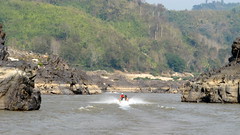
IMG_2714The water was unusually low in February 2010 — the lowest levels in a generation — and navigation was limited to boats with a shallow draft. Our slow boat managed, but barely: the first mate used a bamboo pole to plumb the depth and show the captain as they navigated several rapids. We’d been warned that we would need to walk around one set of rapids and change boats.

Our boat pushed up onto a sandbar and we disembarked, bringing our packs with us to make our way along a path. As the rapids came into view, there was no doubt why this was necessary: a small boat might make it, but jagged rocks across the span would wreck any larger boat foolish enough to try.

Our guide told us that a few days before our cruise, a larger boat had hit a rock further downstream and capsized. Fortunately, nobody had been injured, but the boat was destroyed, and word had quickly spread to cause a steep decline in downriver cruise bookings.

IMG_2747We looked back more soberly at the rapids and rocks from the calmer water where a second boat was waiting, then boarded it for the journey to Pak Beng. Our original boat returned empty to Huay Xai. The low water levels would certainly have an impact on the fortunes of the Mekong boat operators.

IMG_2716Not all impacts are directly negative however. All along the banks we saw people panning for gold. Low water levels expose gravel and sand caught behind otherwise inaccessible underwater rocks — ideal locations for specs of gold to be hidden. Some bars must have been particularly promising because dozens of people were busy digging sand and panning. Our guide told us that river traders would buy gold from these people — mostly otherwise subsistence farmers — and sell it for a profit downstream.

The town of Pak Beng is the only place with accommodation, and depends on river traffic. As fewer boats bring fewer passengers downriver, business will decline for the local guesthouses and restaurants, and the local market will sell less produce from the nearby farms. Fewer boats mean reduced markets for the river fishermen, who sell their catch to passing boats.

IMG_2812By the time we reached Luang Prabang, tributaries had added more water to the Mekong. However, waterline marks on the rocky banks, and the lower extent of the many riverbank gardens along its shores showed that river levels were still below normal expectations.

Luang Prabang has an airport, and is connected by roads to other parts of Laos, but the Mekong River is a powerful draw. As we enjoyed a drink on one of the many terraces overlooking the river, we wondered about the ongoing debates about whether the problem is part of a natural cycle, another sign of global warming, or a result of new dams in China.

For many of the people in Laos, the reasons hardly matter. They rely on the Mekong River, and will certainly suffer if such low levels continue or repeat.

Thursday, February 18, 2010

Slow boat down the Mekong: pay a bit more

The towns of Chiang Khong in northern Thailand and Huay Xai in Laos straddle the Mekong River that defines their common border. Both are heavily reliant on the steady flow of tourists beginning the “classic” boat trip down the Mekong to Luang Prabang.

A burst of activity every morning brings ferry loads of people from the Thai side to wait in immigration lines on the Laotian side before boarding various classes of boat for the downstream journey.

The “fast boats” can make it in seven hours, but the 5–6 people on board have a bumpy, noisy ride, and the helmets they need to wear makes picture-taking impractical.

The “slow boats” take two days, with an overnight stop in Pak Beng. The public versions have wooden benches, and pack in as many people as possible. These are commercial river boats, so can stop for passengers along the way. Many such boats take turns operating as luxury boats, wherein the wooden benches are replaced by comfortable upholstered seats, and carry a limited number of people.

We had been planning to take a slow boat, but were becoming apprehensive after reading forums where people described sore bottoms from hard seats, being stuck in direct sun, excessive drinking and cigarette smoke — as well as a general melee for getting seats and then finding accommodation in Pak Beng. It was beginning to sound like a hassle instead of a highlight.

Amongst the horror stories in a forum thread about the slow boats, one comment about a positive experience prompted me to email Adisak at Nagi of Mekong — despite some followup responses that made him sound unreliable. I got a response immediately. Not only was he prompt, but provided details for days and costs. We had no specific dates at that time, but kept in touch, and by the time we were ready, we let him know. He booked our selected hotel in Chiang Khong (their web site was broken), and picked us up the morning of the cruise. We fully expected to be part of a larger group, but learned that we were alone with one other couple: the entire boat and an English-speaking Lao guide for two days!

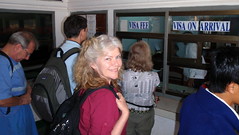
Adisak crossed with us and helped by explaining the crazy immigration process: everyone pushes and congregates at three mall windows as the very methodical Laotian officials process the passports and take cash for the visas as if there was no crowd at all. Knowing that there is a process — however bizarre it may seem — made it a lot easier to cope with!

Passports with new visas in hand, we were whisked off to the boat, where our bags and the other couple were waiting. We thanked Adisak for his help and he waved as we pushed off. We only then realized he hadn’t asked for payment. When I asked Pet, our Lao guide, he nodded and smiled. “It’s okay, pay later.” (We did!)

As we passed the first of the public boats loading up, we were glad to have paid the premium as people with big bags scrambled up to claim the good seats. Slower people, or those less fortunate in the immigration process, would have noisier seats near the back or be stuck on middle of a bench.

The public boat ticket prices are much lower, but an accurate comparison is hard to make. Different sellers charge different rates, and the boats rotate in service, so quality can vary. I spoke to one couple who had paid 1,200 THB each (~C$38) — but then had to pay for the ferry across the river, plus a tuk tuk to take them and their bags to the dock, plus food on board, plus a dismal room in Pak Beng…

For 4,600 THB (~C$144), we had comfortable seats, excellent food on board, a well-informed English-speaking guide, several interesting stops, and a comfortable room with breakfast in Pak Beng.

All of the logistics were looked after for us, so there was almost no stress. We arrived in Luang Prabang feeling relaxed and stimulated.

The extra cost was a very small price to pay for an unforgettable, once-in-a-lifetime trip.